

Published in Slightly Foxed
February 2026
In his 1928 hit, the American singer Harry McClintock conjured a vision of hobo utopia. ‘In the Big Rock Candy Mountains/ All the cops have wooden legs/ And the bulldogs all have rubber teeth/ And the hens lay soft-boiled eggs.’ The song recounts the fantasies of a picaresque American tramp, but its original version presented something darker. Before sanitisation for radio, amid the delights of ‘cigarette trees’ and alcohol ‘trickling down the rocks’, it formerly ended with the lines: ‘I’ve hiked and hiked till my feet are sore/ I’ll be goddamned if I hike any more/ To be buggered sore like a hobo’s whore/ On the Big Rock Candy Mountains.’ This fantasy song describes a young man’s initiation into the often brutal reality of the hobo underground.
Such a fate could easily have befallen the adolescent Jack Black, whose memoir You Can’t Win is a criminal Bildungsroman. After hitting the road in the 1880s, ‘westbound in search of adventure’, he falls in with a couple of older hobos camped beside a creek. But rather than taking advantage of him they teach him the bums’ vocabulary – ‘Java’ is coffee, ‘mulligans’ are stews, and a ‘four-bit micky’ is a bottle of whisky – and some of the tricks of the trade: inveigling food out of the locals and ‘DDing’ or pretending to be deaf and dumb. These men are Black’s first mentors in a life of misadventure.
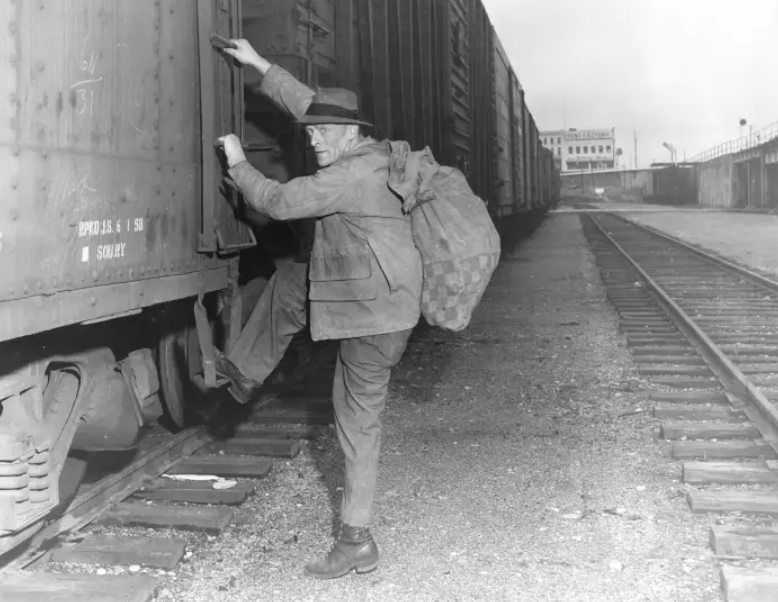
The early part of Black’s career sees him train-hopping across the United States, discovering a fraternity of like-minded ne’er-do-wells. It’s a perilous life: railroad guards, known as ‘bulls’, commonly assault or even murder train-hoppers, and in an early incident Black’s fellow stowaway is crushed to death in a boxcar by sliding timber. Itinerants gather in anarchic ‘conventions’, which are ‘merely an excuse for a big drunk. Sometimes they would end in a killing, or some drunken bum would fall in the fire and get burned to death.’ This is the lawless world in which Black finds his calling: theft.
His first and most influential teacher is a professional thief called Smiler, whom he meets in jail during a stint for vagrancy. Smiler takes Black on as a dedicated apprentice. After a couple of jewellery heists they go to visit Salt Chunk Mary, a legendary fencer of stolen goods – ‘She’ll buy anything from a barrel of whisky to a baby carriage’ – whose establishment in Idaho is the nexus of a criminal economy that stretches across the country. Under Smiler’s tutelage Black progresses from simple scams to meticulously planned felonies, pursuing his craft with an application that, in most other professions, would have earned him the highest praise.
By the age of 25 Black has become ‘an expert house burglar, a nighttime prowler, carefully choosing only the best homes – homes of the wealthy, careless, insured people’. By 30 he has advanced to ‘yegg’, slang for a safe cracker, which earns him respected status in the criminal hierarchy. At 40 he finds himself a ‘solitary, capable journeyman highwayman; an escaped convict, a fugitive, with a background of twenty-five years in the underworld’. Gazing back on this career he writes: ‘I had very few glasses of wine as I traveled this route. I rarely saw a woman smile and seldom heard a song.’ But we sense he somehow has had no choice. From the start, he sees crime as an artform and a vocation.
This dedication is compelling, despite Black’s grubby deeds. After You Can’t Win I happened to read Alan Spence’s novel Night Boat (2103), which follows the life of Hakuin, a Japanese Zen Buddhist master. The books felt oddly similar: two young men setting out on the road – respectively in early twentieth-century America and Japan in the Edo period – living in poverty and travelling constantly, painstakingly and often painfully honing arcane practices. Both attach themselves to mentors who help guide them on their way. Both seek enlightenment of a kind, and both are willing to endure privation and periods of terrible ill health in order to achieve it. Hakuin nearly dies from a spiritual malady called ‘Zen sickness’, while Black’s suffering is chemical: through contacts with Chinese immigrants – who from necessity have, like the hobos, organised themselves into secretive guilds with their own rules, private language and black-market economies – he is introduced to opium, and a decade-long ‘hop’ habit.
This addiction to narcotics parallels his addiction to crime – to put it mildly, he is never someone to do things half-heartedly. His adventures are extraordinary: breaking out of jails, exploding safes with dynamite stolen from mining companies, burying treasure and devising ingenious heists. But what makes You Can’t Win more than a litany of misbehaviour – apart from the quality of Black’s prose, which is witty, precise and clear – are the insights it provides into American society at the time, and especially into the workings of the criminal justice system.
Incarceration is an occupational hazard in Black’s line of work, and he spends years behind bars. He is philosophical about serving time – ‘The first day you are locked up is the hardest, and the last day is the easiest’ – and mostly takes it in his stride. But the punishments can be brutal, including solitary confinement, starvation rations of bread and water, and, on two occasions, flogging. Whether the latter is intended as deterrent or punishment Black is unsure – he only knows that, as a deterrent, it has the opposite effect.
The truth is I wouldn’t have quit, no matter how I was treated. The flogging just hardened me more, that’s all. I found myself somewhat more determined, more confident, and with a feeling that I would play this game of violence to the finish.
The worst treatment he endures is the straitjacket, which almost succeeds in breaking him. Driven half out of his mind, he smashes his head repeatedly against the wall to knock himself out. It makes for horrific reading.
Through these trials Black maintains a remarkable objectivity, observing how such cruelty affects not only him but also those who deal it out. Such practices, he recognises, brutalise both ways.
At Folsom I saw the jacket making beasts of the convicts and brutes of their keepers. I saw Jakey Oppenheimer transformed from a well-intentioned prisoner into a murder maniac whose wanton killings and assaults in prison brought him ‘under the rope’ in the end.
Eventually the Folsom regime provoked a full-scale uprising in which one guard was murdered, and another stabbed multiple times.
Sadly, nothing since then has fundamentally changed. Inmates are no longer flogged, but prison still degrades and hardens those who fall through society’s cracks, and – with over a million people incarcerated in America today – can be said to have comprehensively failed as a deterrent. In his final court appearance, for an attempted stick-up job, Black makes a speech to the judge which lays out in forensic detail the futility of the ‘correctional’ system, describing how his brutal treatment has only succeeded in making him worse. But that speech ends with a vow:
I have promised myself, and I promise the court, that when I finish this sentence I shall look for the best instead of the worst, that I shall look for kindness instead of cruelty, and that I shall look for the good instead of the bad, and when I find them I shall return them with interest. I am confident when I promise the court this that I will not fail. I imagine I have enough character left as a foundation on which to build a reformed life.
When he has served that sentence, that’s exactly what he does. He has weaned himself off opium; now he weans himself off crime. He gets a job as a cashier. He stays straight for thirteen years. By the time he writes his memoir he is working as a librarian for the San Francisco Call.
Jack Black was not his real name, only an alias that stuck. His other pseudonyms included Harry Klein and Thomas Callaghan. His father apparently called him John (‘Well, John, you’ll be what you’ll be, and I cannot help or hinder you,’ were his father’s fatalistic words before Black left home for good; perhaps, in seeking mentors like Smiler, he was looking for a better father). You Can’t Win was published in 1926 and was cited as an influence by William S. Burroughs and other Beat writers. Black disappeared in 1932, perhaps committing suicide.
The opening lines of the book are a portrait of the writer’s face, ‘lined with furrows that look like knife scars’. It’s a face marked by hard knocks, but one that honest citizens might pass on the street and not look at twice. It would have surprised people to know that this quiet librarian contained more stories, and perhaps more wisdom, than most of the books he shelved.